Charity No. 1024624

Legal and Administrative Details
For the Year Ended 31 March 2006
Status The
organisation is a registered charity, registered on 5 August 1993
Governing Document The charity is constituted under a
trust deed dated 24 July 1993.
Charity Number 1024624
Registered Office 179 Bakers Ground
Stoke
Gifford
BS34
8GE
Trustees Edna
Knight
Gillian
Manvell
Marie
Layng
Management Committee Carey Hunt
Sarah Trevitt
Eleanor
Fiske
Michael
Patterson
Staff Beverly
Searle Development Director
Marion
Mitchell Family Support Officer
Prisca
Middlemiss Information Officer
Julie
Griffin Finance Officer
Medical Advisor Professor Maj Hulten
Bankers National
Westminster Bank Plc Charities
Aid Foundation
Hanley
St1
1QA
Auditors Godfrey
Wilson Ltd
Chartered
Accountants & Registered Auditors
48
Minchinhampton
Gloucestershire
GL6
9JA
The
trustees are pleased to present their report and audited financial statements
for the year ended 31 March 2006.
Legal
and administrative information set out on page 1 forms part of this
report. The financial statements comply
with current statutory requirements, the memorandum and articles of association
and the Statement of Recommended Practice – Accounting and Reporting by
Charities (issued in March 2005).
Structure, Governance and Management
The
Rare Chromosome Disorder Support Group, known as “Unique”, became a registered
charity on 24 July 1993.
A
board of trustees is responsible for the overall governance of the
charity. Trustees are either named
within the constitution or are elected.
Unique has three trustees and a management committee of seven members
(including trustees) which meets with staff and the charity’s chief medical
advisor at least four times a year to review the group’s work and formulate
strategy. Unique also benefits from the
services of professional medical advisors who liaise with the charity’s
employees.
Unique
employs five members of staff
two full-time and three part-time.
The charity benefits from the donated services of members who use their
professional skills and knowledge to assist the group in areas including ICT,
fundraising, marketing, creative design, copywriting, HR and legal advice as well
as with general administrative support.
The Development Director is responsible to the management committee for
the day to day operations of the charity and implements policies agreed by the
board of trustees. The Finance Officer
assists the Development Director in financial matters.
A
risk register is maintained to identify and monitor implications for the
charity should its main strategic goals not be achieved or operating conditions
change. The register is under review,
with contingency plans to deal with challenges that might arise.
The
response from families and professionals to the work of Unique is logged and
reviewed continuously. Feedback arrives
by letter, telephone, email and via the private members’ forum of the Unique
website or through information submitted for publication in the charity’s
magazine. The introductory pack sent to
new inquirers contains a basic evaluation form and service guide sheets. More detailed evaluation forms are included
with letters sent out by the Assistant Information Officer and in conference
and study day packs. The direction of
future work is influenced by feedback from members.
Company limited by guarantee
At a general meeting of members of the Rare Chromosome Disorder Support Group on 23 April 2005, an extraordinary resolution was passed
accepting the trustees' proposal to transfer the assets, liabilities
and activities of the charity to a newly formed company limited by
guarantee. Unique RCD Ltd, sharing the aims and objectives of the
original charity, was duly incorporated on 23 May 2005 with the
approval of the Charities Commission. Subsequently the
company name was changed to Rare Chromosome Disorder Support Group and
registered in
Objectives
and Activities
Objects
Unique
aims to provide links between families whose children have similar clinical
and/or practical problems caused by rare chromosome disorders. A rare chromosome disorder causing
disabilities and health problems can occur in at least one in every 1,000 live
births. The overall figure for any rare
chromosome disorder (including balanced rearrangements that do not cause
disability and ill health) is at least one in 200 live births.
Unique
aims to raise awareness of rare chromosome disorders, their high incidence and
their significance, both in the
Activities
Unique’s
core charitable activities are categorised under two primary headings:
1.
Family Support Services
Unique
acts as an international support group and aims to provide the following core
services on an ongoing basis:
§
A high-quality
magazine produced three times each year and distributed to members. This publication is the ‘face’ of Unique to
many families.
§
A
comprehensive website at www.rarechromo.org, which attracts the worldwide rare
chromosome disorder community to Unique.
§
A 24-hour helpline service
to support families needing information and to relieve parents and carers in
times of distress and isolation.
§
An annual
conference held in the UK to bring together families and professionals and
share knowledge of advances in diagnosis as well as information helpful in the
daily lives of those affected by a rare chromosome disorder.
To
provide the core support group services, Unique has developed the following
resources:
§ A confidential offline database updated at least once a year, which keeps individual records showing the lifetime effects and consequences of specific rare chromosome disorders on each affected member of Unique. This constitutes a unique resource that is not available anywhere else in the world. The Unique database manager uses the data to respond to requests for information from clinical geneticists, researchers and other professionals as well as from families and people with rare chromosome disorders.
§
The Unique information
project, which builds on our range of published material to support
more families affected by rare chromosome disorders
§
Indirect
family support delivered via professionals
which builds on our existing relationships with professional bodies and
individuals working with families affected by rare chromosome disorders,
including contributions to medical research into the effects and health issues
relating to rare chromosome disorders.
2. Awareness raising
Unique
aims to educate the general public about rare chromosome disorders through
talks and presentations and using national and local media when appropriate.
Achievements
and Performance
1. Family Support
Services
Membership
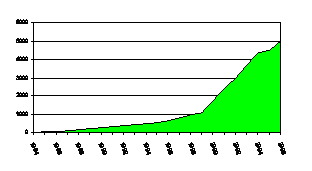
of Unique continues to grow at
a steady rate, illustrated by the following figures.
|
|
31 March
2004 |
31 March
2005 |
31 March
2006 |
|
Family Members
(cumulative) |
4,000 |
4,500 |
4,920 |
|
New families |
488 |
412 |
400 |
|
Total countries |
64 |
65 |
68 |
Magazine
 We publish a highly acclaimed magazine three times a year in
which families and professionals share their knowledge and experiences. The magazine contains information on topics
such as health-related, behavioural and disability issues and how to cope with
them, relevant disability and health legislation, financial and benefits
information and education for children with special needs, as well as a focus
on advances in genetic knowledge and testing and reproduction options. The full-colour magazine is professionally
produced to a high standard. Each issue
costs £10,000 to produce and distribute to members.
We publish a highly acclaimed magazine three times a year in
which families and professionals share their knowledge and experiences. The magazine contains information on topics
such as health-related, behavioural and disability issues and how to cope with
them, relevant disability and health legislation, financial and benefits
information and education for children with special needs, as well as a focus
on advances in genetic knowledge and testing and reproduction options. The full-colour magazine is professionally
produced to a high standard. Each issue
costs £10,000 to produce and distribute to members.
A
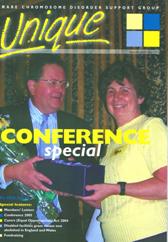
special edition of the magazine brought information from the October 2005
conference to 4,800 member families worldwide.
Website: www.rarechromo.org
|
|
31 March
2004 |
31 March
2005 |
31 March
2006 |
|
Website ‘hits’ |
87,798 |
119,569 |
170,193 |
|
Messages posted on
members’ forum |
2,000 |
2,352 |
2,876 |
Members
can go to “collect” an electronic version of the magazine from the new magazine
archive held in the password-protected part of the website. So far over 500 member families have chosen
the electronic delivery route, saving the group a considerable sum in postage
and printing costs.
The
Development Director and her husband, an IT consultant, worked throughout the
year to develop the new website, launched in March 2006. Over 50 booklets and flyers about rare
chromosome disorders can be accessed through and downloaded from the
password-protected members’ area with many more to come, along with new areas
for professionals and ‘Friends of Unique’.
Over
200 hours were donated by Trevor Searle to develop the site in addition to the
regular hours he devotes to developing and maintaining the Unique database and
ICT capacity. Mr Searle’s professional
time dedicated this year alone to the charity has been valued at £20,000.
Helpline
|
|
31 March
2004 |
31 March
2005 |
31 March
2006 |
|
Telephone enquiries
(cumulative) |
4,500 |
5,200 |
6,000 |
|
Email enquiries
(cumulative) |
32,146 |
49,560 |
73,200 |
The Development
Director continues to support the 24-hour helpline and acts as the initial
point of contact for all new families.
Conference
The
11th Unique conference took place from 21 to 23 October 2005 at the
Daventry Hotel,
A
conference
report is available to the public on the home page of
www.rarechromo.org – the charity’s website.
Trustees’ summary
The
trustees are delighted by the excellent outcomes of the charity’s Family
Support Services. The Unique magazine
continues to be an excellent production and has evolved significantly from its
beginning as a basic newsletter. The 11th
Unique conference was a highly successful weekend and the feedback from members
proves it to be a worthwhile activity that is valued immensely. Thanks go to the Family Support Officer who
works tirelessly to ensure that each conference is even better than the
last. It is regrettable that
insufficient income prevents Unique from holding the conference annually.
The
trustees recognise that the huge frontline response to families, much of it
bespoke, is generated by a tiny number of highly dedicated staff. Thanks are due to all employees who work hard
to support families by providing prompt information and creating opportunities
for social contact to relieve often profound feelings of isolation. Special mention must be made of the long
hours put in by the Development Director herself to provide an instant response
of the highest quality to every inquiry.
To provide more support to staff performing an invaluable service is at
the heart of trustees’ current concerns over resources.
Maintaining the Unique Database
Unique
maintains a comprehensive offline database detailing lifetime effects of
specific chromosome disorders on individual members, providing an invaluable
source of information for new and existing members and professionals. From the database, staff are able to provide
inquiring professionals with anonymised information about the effects of a
specific rare chromosome disorder. This
is particularly helpful when there is no Unique information leaflet on a
specific condition. Feedback from
professionals, especially geneticists and paediatricians, has demonstrated that
this service has proved invaluable to them in counselling and managing affected
families.
An
anonymised shortened version of the full Unique database is held on the public
website, allowing professionals and families themselves to search through the
specific rare chromosome disorders (with
karyotype where available) of every affected member in the group.
The
database was redesigned in 2005 to accommodate more detailed information about
individual members than before. We
anticipate providing an increasing amount of assistance to research projects in
future, at all times protecting members’ confidentiality.
Information Project
For three years the Information Officer has researched and produced family-friendly, medically verified leaflets and flyers on more than 60 specific chromosome disorders. Most of these are now available to our members via a password-protected area on our website.
Chromosome disorder booklets and flyers available from
Unique to date include:
|
· Pallister Killian syndrome · Mowat Wilson syndrome · Robertsonian translocations · Jacobsen syndrome |
· XYY introduction · XXYY syndrome · XYYY syndrome · XXYY syndrome · XXXXY syndrome · Pentasomy X · Tetrasomy X |
·
Mosaic
trisomy 16 ·
Trisomy 8
Mosaicism ·
Trisomy 9
Mosaicism ·
Uniparental
Disomy 14 ·
Diploidy
triploidy ·
Triploidy ·
Idic 15 |
· Ring 2 · Ring 13 · Ring 14 · Ring 15 · Ring 18 · Ring 20 · Ring 21 · Ring 22 |
·
1q
duplications ·
4p
duplications ·
5p
duplications ·
7q
duplications ·
8q
duplications ·
8p
duplications ·
8p Inv dup ·
9p
duplications ·
17p
duplications |
·
Deletions
1p36 ·
1q4
deletions ·
Deletion
2q37 ·
Deletion
3p25 ·
3q2
deletions ·
5q22
deletions ·
6p deletions
·
7q36
deletions ·
Deletion
8p23.1 ·
9p deletions ·
10q26
deletions ·
11p
deletions ·
13q
deletions ·
21q
deletions |
The
full range of Unique publications includes:
·
 Little
Yellow Book - volume 1, a guide to rare chromosome disorders for families and
non-genetics professionals. The book
translates technical terminology and complicated scientific concepts into
accessible language.
Little
Yellow Book - volume 1, a guide to rare chromosome disorders for families and
non-genetics professionals. The book
translates technical terminology and complicated scientific concepts into
accessible language.
·
Unique Tales, a cartoon strip aimed at 7 to 10 year olds to help explain
rare chromosome disorders to siblings of affected children.
·
Volume 2 of
the Little Yellow Book series
continued to evolve over the last 12 months and is near completion. Publication
was delayed to include details of new molecular techniques such as DNA
microarray technology. Illustrations for
the book are complete and the book should go to print in Summer 2006.
The
Assistant Information Officer has prepared articles for the magazine on a wide
range of topics affecting families’ daily lives (e.g. carers’
and disability legislation, educational
issues and communication for disabled children). They are available from the public pages of
our website.
Additional
Unique leaflets on subjects of particular interest to our member families
include:
·
Behaviour,
completed and verified by a consultant psychiatrist, Dr Sarah Bernard and a
behavioural therapist, Natasa Momcilovic based at the Michael Rutter Centre,
·
Discrimination,
almost completed; Dame Philippa Russell, a Disability Rights Commissioner and
eminent campaigner has kindly agreed to verify it
Trustees’ summary
The
Trustees are very grateful to the Information Officer and Development Director
for their commitment to producing the range of information on specific rare
chromosome disorders that we have to date. The information project is the jewel
in our crown as it provides a truly unique service to these families and the
professionals supporting them. It is the
trustees’ intention that the information project should continue and to that
end, some funds have been secured. Additional
investment will be sought to ensure expansion.
We
are grateful, too, to the Assistant Information Officer for the quality of her
response to families’ need for more general information on issues that affect
their lives with children who may develop multiple and complex needs including
highly challenging behaviour that is often misunderstood by the wider
community. The response from other
disability support groups indicates how valued her work has been and the
trustees hope to be in a position to continue to provide this service when the
dedicated grant runs out in 2006.
Indirect Family Support delivered
via Professionals
Unique
informs professionals, including geneticists, GPs, paediatricians, special
needs teachers and social workers, health visitors, community paediatric nurses
and midwives as well as members of other support groups, on how the group
offers information and support when a family is newly diagnosed. This has been
achieved in a number of ways:
·
Unique has
carried out a targeted awareness-raising mailshot in the
·
Unique has
given numerous presentations to professionals over the past 12 months and has
been invited to contribute as expert patient representative to a number of
professional committees and working groups.
Although by no means exhaustive, examples include:
§
presenting to
midwives and young cytogeneticists attending the first three genetics education
courses run by the
§
representing
Unique on the
·
Unique has
been pivotal in helping to develop a virtual network (Eurochromnet) of RCD
support groups across Europe aimed at raising awareness and spreading high
quality information and best practice across the Continent, while breaking down
language and cultural barriers. Unique is an active member of the European Rare
Diseases Organisation and provides advice to the Human Genetics Commission.
·
Unique has
presented at the British Society of Human Genetics Annual Conference and, for
the last three years, was invited to participate with an awareness-raising
stand that attracted widespread attention. The majority of delegates were
clinical geneticists, genetic counsellors, genetic nurses, cytogeneticists and
molecular geneticists from across the
Unique
is a partner in two pan-European projects involving a wide range of genetics
professionals and researchers:
·
Unique was invited by the co-ordinator
Professor J-J Cassiman of the
·
Unique is a
partner in a second EC project, SAFE (Special
Non-Invasive Advances in Foetal and Neonatal Evaluation), a network of
excellence involving 50 research groups from across Europe investigating non-invasive
methods of testing and diagnosis for genetic abnormalities both in utero and in the neonatal stage.
·
Unique works
co-operatively with colleagues from the Advisory Panel of the UK Rare Disorders
Forum and from WellChild (www.wellchild.org.uk). The main involvement is in developing the proposed Rare Disorders Mapping Project
in the
Trustees’ summary
The
trustees are pleased that relationships with key professionals keep the group
expanding and enhance the quality of its work and reputation. We are proud of the reputation that Unique
has developed among genetics and other professionals, due entirely to the
knowledge and skills of our key staff.
Unique could not operate without support from the medical professionals
who work with affected families and will continue to invest resources in this
important area.
2. Awareness Raising
Unique
runs a UK and global network of local contacts who distribute the group’s
awareness-raising posters and information leaflets to local hospitals, social
work departments, doctors’ surgeries and special schools. New members receive an introductory pack with
awareness-raising literature to distribute in their local area.
Unique
is promoted on innumerable public information databases and has established
good working relationships with Contact a Family
(CaF) and the Genetic Interest Group (GIG). Both CaF and GIG refer families and individuals
affected by rare chromosome disorders to Unique.
Unique
raises awareness of rare chromosome disorders and of the support group through
local and national media and actively encourages families to mention Unique in
any press articles or radio or television interviews in which they may get
involved.
Trustees’ summary
The trustees are pleased with the positive results from contacts made with genetics professionals and other support groups as well as with the wider world. Tailoring Unique’s resources to its income will continue, however, to restrict expansion of Unique’s existing capacity and until income increases, publicity campaigns must remain reactive rather than proactive. It is important that Unique’s ability to offer a first-class service to new and existing family members remains unimpaired. Without more resources, Unique would not be able to respond to the results of a high-profile advertising campaign, however desirable this might be from the perspective of all families with a chromosome disorder and of those who support them.
Financial
Review
Main Sources of funding
1. Donations and
Gifts
Primarily unrestricted income received from members, their
friends and family. There has been some
small increase this year in corporate donations from members’ employers. Regular giving also increased slightly this
year due to raised awareness of the need for funds among members.
2. Volunteer
Fundraising
Unrestricted income from the activities of individual
members who organise local events such as coffee mornings, cake sales, etc. or
who take part in national sponsorship events such as the London Marathon and
Great North Run.
3. Internal
Fundraising
Unrestricted income generated directly from the sale of
Christmas Cards and merchandise to Unique members and their family and
friends. Advertising to members is
principally through the Unique magazine and website.
4. Grants
Unique was particularly grateful to receive a number of
grants this year. Donors included:
·
The Health
Foundation ~ contributes to the running costs of the information project
·
Children in
Need ~ restricted funding to support the Assistant Information Officer’s post
·
VICTA ~
contributes to the Family Support Officer’s post.
5. Interest and
Investments
Income
is generated from bank interest and Gift Aid.
In September 2005, two Tracey Emin prints, “Little Family”,
were donated to Unique, valued independently at £700 each.
Trustees’ summary
The
trustees would like to thank everyone who contributed to the work of Unique,
whether through fundraising, donations or grants. We rely heavily on voluntary income to carry
on the valuable work of supporting all Unique families. It is our view that costs associated with
fundraising activities have been low.
We
should like to comment on the significant reduction in income during 2005/6
compared to the previous year. In 2004/5
Unique was exceptionally fortunate to receive major grants. In 2005/6, like most other
In
light of the environmental factors beyond our control, the trustees decided
that for a limited period, it would be appropriate to use the charity’s
reserves to ensure that services were maintained at their existing level so that
no beneficiary family was affected.
In
this situation, the trustees wish to thank particularly the Finance Officer,
who has prepared prompt and detailed monthly management accounts to enable us
to take well-informed strategic decisions about the group and its ongoing
commitments. As well, she has played a
leading role in the ongoing search for funds to enable the group to continue
its vital work. Again, this staff
member works hard far beyond the number of hours for which she is paid by the
group and we value her efforts highly.
In
2006/7 the trustees will focus attention on a growth strategy for the charity
to secure its long-term future.
Expenditure
Family Support Services
Costs
associated with the magazine are proportionate to the increase in membership,
the increase in content of the magazine and related postage costs. Website and helpline running costs continue
to be managed efficiently and as mentioned previously are subsidised
significantly by voluntary support. The
Unique conference was delivered within the agreed budget and subsidised by fees
charged to attending member families as well as by donations and
fundraising. Additional investment would
be required to support an annual conference.
The
cost of maintaining the Unique database has been significantly
under-resourced. Next year, investment
in the database will be urgently required to maximise the potential of this
irreplaceable asset.
The
information project has delivered well above the expected outcomes. Sixty booklets exceeded the original 40
planned for the end of March 2006. The quantity of database information could
yield hundreds of condition-specific publications. Additional investment is required to extend
the capacity of the information project and to run study days on individual
rare chromosome disorders.
Resources
used to support families via professionals are within budget. With additional
expenditure, the service could be extended to provide more information and
support to professionals serving the rare chromosome disorder community.
Awareness Raising
Considering
that there are just two full-time employees representing Unique at a
significant number of events and seeking further opportunities to present to a
wide range of audiences, the trustees are particularly pleased with the
outcomes achieved in relation to the relatively low expenditure.
Gifts in Kind
Like
many charities, Unique relies heavily on the generosity of individuals who
contribute their professional expertise free of charge. The trustees wish to extend
their sincere thanks to all these generous supporters and to mention
particularly the following individuals:
Trevor
Searle, for his expertise, time and inexhaustible patience spent on improving
and maintaining the Unique website and online capabilities. Without this free in-house resource, Unique
would not have been able to develop and maintain its website and database.
Professor
Maj Hulten, who has been a major influence and support in the work with EC
partners as well as spending countless hours checking and verifying Unique’s
publications on specific disorders.
Carey Hunt, who
provides her professional creative skills to design the excellent Unique
publications.
Eleanor
Fiske, committee member and director/secretary of the new charitable company,
whose professional experience and energy ensured a smooth transfer to the new
company limited by guarantee and who continues to freely provide both legal and
secretarial advice to the group.
Michael
Patterson, committee member and now director, who provided sound governance
advice and produced the charity’s first formal risk register.
Governance
costs have been kept to a very low level.
Trustees rarely claimed expenses and travel and meeting costs have been
minimal.
The
trustees wish to thank, too, the busy volunteers who continue to despatch the
magazine three times a year, a Herculean task, as well as those members who
gave of their time to help out behind the scenes to make the 2005 conference
such a success.
Reserves Policy
The
trustees aim to hold between 3 and 6 months of expenditure in reserves, which
equates to £45,000 to £95,000 in general funds. At this level, the trustees
feel that they would be able to honour current commitments in the event of a
significant drop in income. At 31 March
2006, unrestricted funds of £86,303 were held, which is in line with the
reserves policy.
Plans
for the Future
The
Trustees’ immediate plans for the future include:
·
Continuing to
provide existing support for families affected by rare chromosome disorders in
order to relieve feelings of isolation and despair.
·
Expanding
services to meet the growing demand from both existing members and new members
each year.
·
Continuing to
develop the information project and to increase income to permit an expansion
of this service while reducing the current unreasonable burden on existing
staff who work well beyond their paid hours to meet needs.
·
Developing a
strategy to make the charity’s core activities: helpline, magazine, database
and information project self-sustaining.
·
Developing an
operating plan to boost income in order to fulfil the objectives of the charity
on a long-term basis.
In
March 2006 Unique began working with Pilotlight, a non-profit organisation
marrying business mentors to charities wishing to develop their
operations. The trustees are pleased to
report that in their view, the emerging relationship with Pilotlight holds
promise for the future of Unique.
Statement of Responsibilities of The Trustees
The trustees are required to prepare financial statements
for each financial year, which give a true and fair view of the state of
affairs of the charitable company and of its incoming resources and application
of resources, including the net income or expenditure, for the period. In
preparing those financial statements the trustees are required to:
§
select
suitable accounting policies and then apply them consistently;
§
make
judgements and estimates that are reasonable and prudent;
§
state
whether applicable accounting standards and statements of recommended practice
have been followed, subject to any material departures disclosed and explained
in the financial statements; and
§
prepare
the financial statements on the going concern basis unless it is inappropriate
to presume that the charity will continue in operation.
The trustees are responsible for
keeping proper accounting records which disclose with reasonable accuracy at
any time the financial position of charity and which enable them to ensure that
the financial statements comply with the Charities Act 1993. The trustees are
also responsible for safeguarding the assets of the charity and hence for
taking reasonable steps for the prevention and detection of fraud and other
irregularities.
The Trustees
The trustees who served during the year and up to the date
of this report were as follows:
Edna Knight
Gillian Manvell
Marie Layng
The trustees have no beneficial interest in the charity.
Auditors
Godfrey Wilson Limited were
re-appointed as the charity's auditors during the year, and they expressed their
willingness to continue in this capacity.
Approved by the trustees on 1 July 2006 and signed on their
behalf by

Edna Knight
- Group Co-ordinator
Independent
Auditors' Report
To the
Trustees of
The Rare Chromosome Disorder Support Group
We have audited the financial statements of The Rare
Chromosome Disorder Support Group for the year ended 31 March 2006 which
comprise the statement of financial activities, balance sheet and related
notes. These financial statements have been prepared in accordance with the
accounting policies set out therein and the requirements of Statement of
Recommended Practice: Accounting and Reporting by Charities (issued in March
2005).
This report is made solely to the trustees, as a body, in
accordance with section 44 of the Charities Act 1993. Our audit work has been
undertaken so that we might state to the trustees those matters we are required
to state to them in an auditors' report and for no other purpose. To the
fullest extent permitted by law, we do not accept or assume responsibility to
anyone other than the charity and the trustees as a body, for our audit work,
for this report, or for the opinions we have formed.
Respective Responsibilities of The Trustees and Auditors
The trustees are responsible for preparing the trustees'
report and the financial statements in accordance with applicable law, United
Kingdom Accounting Standards (United Kingdom Generally Accepted Accounting
Practice) and the Statement of Recommended Practice: Accounting and Reporting by
Charities (issued in March 2005). The responsibilities of the trustees are set
out in the statement of responsibilities of the trustees.
We have been appointed as auditors under section 43 of the
Charities Act 1993 and report in accordance with regulations made under section
44 of that act. Our responsibility is to audit the financial statements in
accordance with relevant legal and regulatory requirements and International
Standards on Auditing (
We report to you our opinion as to whether the financial
statements give a true and fair view and are properly prepared in accordance
with the Charities Act 1993. We report to you whether, in our opinion, the
information given in the trustees' report is consistent with the financial
statements. We also report to you if the charity has not kept proper accounting
records, or if we have not received all the information and explanations we
require for our audit.
We read other information contained in the annual report,
and consider whether it is consistent with the audited financial statements.
This other information comprises only the report of the trustees. We consider
the implications for our report if we become aware of any apparent
misstatements or material inconsistencies with the financial statements. Our
responsibilities do not extend to any other information.
Basis of Opinion
We conducted our audit in accordance with International
Standards on Auditing (
We planned and performed our audit so as to obtain all the
information and explanations which we considered necessary in order to provide
us with sufficient evidence to give reasonable assurance that the financial
statements are free from material misstatement, whether caused by fraud or
other irregularity or error. In forming our opinion we also evaluated the
overall adequacy of the presentation of information in the financial
statements.
We planned and performed our audit so as to obtain all the
information and explanations which we considered necessary in order to provide
us with sufficient evidence to give reasonable assurance that the financial
statements are free from material misstatement, whether caused by fraud or
other irregularity or error. In forming our opinion we also evaluated the
overall adequacy of the presentation of information in the financial
statements.
Opinion
In our opinion:
§
the
financial statements give a true
and fair view, in accordance with United Kingdom
Generally Accepted Accounting Practice as modified by the Statement of
Recommended Practice: Accounting and Reporting by Charities (issued in March
2005), of the charity's state of affairs as at 31 March 2006 and of
its incoming resources and application of resources, including its income and
expenditure, for the year then ended;
§
the
financial statements have been properly prepared in accordance with the Charities Act 1993; and
§
the
information given in the trustees' report is consistent with the financial
statements.

1 July 2006
GODFREY WILSON LIMITED
Chartered Accountants &
Registered Auditors
48
Minchinhampton
Gloucestershire
GL6 9JA
|
|
|||||||||||||
|
Statement
of Financial Activities |
|
|
|
|
|
|
|
|
|
|
|
|
|
|
|
|
|
|
|
|
|
|
|
|
|
|
|
|
|
For
the Year Ended 31 March 2006 |
|||||||||||||
|
|
|
|
|
|
|
|
|
|
|
|
|
|
|
|
|
|
|
|
|
|
|
|
|
|
|
2006 |
|
2005 |
|
|
|
|
|
|
|
|
Restricted |
|
Unrestricted |
|
Total |
|
Total |
|
|
|
|
|
|
|
Note |
£ |
|
£ |
|
£ |
|
£ |
|
|
|
|
|
|
|
|
|
|
|
|
|
|
|
|
Incoming
Resources |
|
|
|
|
|
|
|
|
|
|
|||
|
Incoming
Resources from Generated Funds: |
2 |
|
|
|
|
|
|
|
|||||
|
|
Voluntary
Income |
|
|
|
- |
|
80,864 |
|
80,864 |
|
131,003 |
||
|
|
Activities
For Generating Funds |
|
- |
|
31,304 |
|
31,304 |
|
47,923 |
||||
|
|
Investment
Income |
|
|
|
- |
|
4,296 |
|
4,296 |
|
3,924 |
||
|
Incoming
Resources from Charitable Activities: |
3 |
|
|
|
|
|
|
|
|||||
|
|
Family
Support Services |
|
|
|
|
|
15,312 |
|
3,772 |
|
19,084 |
|
33,957 |
|
|
Awareness
Raising |
|
|
|
|
|
- |
|
- |
|
- |
|
- |
|
|
|
|
|
|
|
|
|
|
|
|
|
|
|
|
Total
Incoming Resources |
|
|
15,312 |
|
120,236 |
|
135,548 |
|
216,807 |
||||
|
|
|
|
|
|
|
|
|
|
|
|
|
|
|
|
Resources
Expended |
|
|
|
|
|
|
|
|
|
|
|
|
|
|
Costs
of Generating Funds: |
|
|
|
|
|
|
|
|
|
|
|
|
|
|
|
Fundraising
& Merchandise Costs |
|
|
|
|
|
1,928 |
|
11,818 |
|
13,746 |
|
15,457 |
|
Charitable
Activities: |
|
|
|
|
|
|
|
|
|
|
|||
|
|
Family
Support Services |
|
|
30,857 |
|
121,746 |
|
152,603 |
|
106,940 |
|||
|
|
Awareness
Raising |
|
|
|
1,095 |
|
11,521 |
|
12,616 |
|
12,288 |
||
|
Governance
Costs |
|
|
|
514 |
|
7,048 |
|
7,562 |
|
8,462 |
|||
|
|
|
|
|
|
|
|
|
|
|
|
|
|
|
|
Total
Resources Expended |
|
|
|
|
4 |
34,394 |
|
152,133 |
|
186,527 |
|
143,147 |
|
|
|
|
|
|
|
|
|
|
|
|
|
|
|
|
|
Net
Incoming / (Outgoing) Resources Before Transfers |
5 |
(19,082) |
|
(31,897) |
|
(50,979) |
|
73,660 |
|||||
|
|
|
|
|
|
|
|
|
|
|
|
|
|
|
|
Transfers
Between Funds |
|
|
|
|
|
231 |
|
(231) |
|
- |
|
- |
|
|
|
|
|
|
|
|
|
|
|
|
|
|
|
|
|
Net
Movement in Funds |
|
|
|
|
|
(18,851) |
|
(32,128) |
|
(50,979) |
|
73,660 |
|
|
|
|
|
|
|
|
|
|
|
|
|
|
|
|
|
Reconciliation
of Funds |
|
|
|
|
|
|
|
|
|
|
|||
|
Total
Funds Brought Forward |
|
|
22,146 |
|
115,136 |
|
137,282 |
|
63,622 |
||||
|
|
|
|
|
|
|
|
|
|
|
|
|
|
|
|
Total
Funds Carried Forward |
|
3,295 |
|
83,008 |
|
86,303 |
|
137,282 |
|||||
|
|
|
|
|
|
|
|
|
|
|
|
|
|
|
|
|
|
|
|
|
|
|
|
|
|
|
|
|
|
|
All of the above results are derived from continuing
activities. There were no other recognised gains or losses other than those
stated above. Movements in funds are disclosed in Note 13 to the financial
statements. |
|||||||||||||
|
|
|||||||||||||
|
Balance
Sheet |
|
|
|
|
|
|
|
|
|
|
|||
|
|
|
|
|
|
|
|
|
|
|
|
|
|
|
|
As at
31 March 2006 |
|||||||||||||
|
|
|
|
|
|
|
|
|
|
|
|
|
|
|
|
|
|
|
|
|
|
|
|
|
|
|
2006 |
|
2005 |
|
|
|
|
|
|
|
|
|
Note |
£ |
|
£ |
|
£ |
|
|
|
|
|
|
|
|
|
|
|
|
|
|
|
|
Fixed
Assets |
|
|
|
|
|
|
|
|
|
|
|
||
|
Tangible
Fixed Assets |
|
|
|
|
8 |
|
|
675 |
|
1,013 |
|||
|
Investments |
|
|
|
|
|
|
9 |
|
|
1,400 |
|
- |
|
|
|
|
|
|
|
|
|
|
|
|
|
|
|
|
|
|
|
|
|
|
|
|
|
|
|
|
2,075 |
|
1,013 |
|
|
|
|
|
|
|
|
|
|
|
|
|
|
|
|
Current
Assets |
|
|
|
|
|
|
|
|
|
|
|
||
|
Debtors |
|
|
|
|
|
|
10 |
2,350 |
|
|
|
3,158 |
|
|
Cash at
Bank and in Hand |
|
|
|
|
|
90,478 |
|
|
|
137,399 |
|||
|
|
|
|
|
|
|
|
|
|
|
|
|
|
|
|
|
|
|
|
|
|
|
|
|
92,828 |
|
|
|
140,557 |
|
|
|
|
|
|
|
|
|
|
|
|
|
|
|
|
|
|
|
|
|
|
|
|
|
|
|
|
|
|
|
Creditors:
Amounts Due Within 1 Year |
|
|
11 |
8,600 |
|
|
|
4,288 |
|||||
|
|
|
|
|
|
|
|
|
|
|
|
|
|
|
|
Net
Current Assets |
|
|
|
|
|
|
|
84,228 |
|
136,269 |
|||
|
|
|
|
|
|
|
|
|
|
|
|
|
|
|
|
Net
Assets |
|
|
|
|
|
|
12 |
|
|
86,303 |
|
137,282 |
|
|
|
|
|
|
|
|
|
|
|
|
|
|
|
|
|
|
|
|
|
|
|
|
|
|
|
|
|
|
|
|
|
|
|
|
|
|
|
|
|
|
|
|
|
|
|
|
|
|
|
|
|
|
|
|
|
|
|
|
|
|
Funds |
|
|
|
|
|
|
13 |
|
|
|
|
|
|
|
Restricted
Funds |
|
|
|
|
|
|
|
3,295 |
|
22,146 |
|||
|
Unrestricted
Funds: |
|
|
|
|
|
|
|
|
|
|
|||
|
|
General
Funds |
|
|
|
|
|
|
|
83,008 |
|
115,136 |
||
|
|
|
|
|
|
|
|
|
|
|
|
|
|
|
|
Total
Funds |
|
|
|
|
|
|
|
|
86,303 |
|
137,282 |
||
|
|
|
|
|
|
|
|
|
|
|
|
|
|
|
|
|
|
|
|
|
|
|
|
|
|
|
|
|
|
|
Approved
by the trustees on 1 July 2006 and signed on their behalf by |
|||||||||||||
|
|
|
|
|
|
|
|
|
|
|
|
|
|
|
|
|
|
|
|
|
|
|
|
|
|
|
|||
|
|
|
|
|
|
|
|
|
|
|
||||
|
|
|
|
|
|
|
|
|
|
|
|
|
|
|
|
|
|
|
|
|
|
|
|
|
|
|
|
|
|
|
Edna
Knight |
|
|
|
|
Gillian
Manvell |
|
|
|
|
||||
|
The Rare Chromosome Disorder Support Group |
|||||||||||||
|
|
|||||||||||||
|
Notes
to the Financial Statements |
|
|
|
|
|
|
|
|
|||||
|
|
|
|
|
|
|
|
|
|
|
|
|
|
|
|
For the Year Ended 31 March 2006 |
|||||||||||||
|
|
|
|
|
|
|
|
|
|
|
|
|
|
|
|
|
|
|
|
|
|
|
|
|
|
|
|
|
|
|
1. |
Accounting
Policies |
|
|
|
|
|
|
|
|
|
|
||
|
|
|
|
|
|
|
|
|
|
|
|
|
|
|
|
a) |
The financial statements have been prepared under the
historical cost convention and in accordance with applicable accounting
standards and the Charities Act 1993. They follow the recommendations in the
Statement of Recommended Practice, Accounting and Reporting by Charities
(issued in March 2005). |
||||||||||||
|
|
|
|
|
|
|
|
|
|
|
|
|
|
|
|
b) |
Voluntary income is received by way of donations and gifts
and is included in full in the statement of financial activities when
receivable. |
||||||||||||
|
|
|
|
|
|
|
|
|
|
|
|
|
|
|
|
c) |
Revenue grants are credited to the Statement of Financial
Activities when received or receivable which ever is earlier, unless they
relate to a specific future period, in which case they are deferred. |
||||||||||||
|
|
|
|
|
|
|
|
|
|
|
|
|
|
|
|
d) |
Resources expended are recognised in the period in which
they are incurred. Resources expended
include attributable VAT which cannot be recovered. |
||||||||||||
|
|
|
|
|
|
|
|
|
|
|
|
|
|
|
|
e) |
Depreciation is provided at rates calculated to write down
the cost of each asset to its estimated residual value over its expected
useful life. The depreciation rates in use are as follows: |
||||||||||||
|
|
|
|
|
|
|
|
|
|
|
|
|
|
|
|
|
|
Computer
equipment |
|
|
4 years |
|
|
|
|
||||
|
|
|
|
|
|
|
|
|
|
|
|
|
|
|
|
|
Items of equipment are capitalised where the purchase
price exceeds £500. |
||||||||||||
|
|
|
|
|
|
|
|
|
|
|
|
|
|
|
|
f) |
Restricted funds are to be used for specific purposes as
laid down by the donor. Expenditure
which meets these criteria is charged to the fund. |
||||||||||||
|
|
|
|
|
|
|
|
|
|
|
|
|
|
|
|
g) |
Unrestricted funds are donations and other incoming
resources received or generated for the charitable purposes. |
||||||||||||
|
|
|
|
|
|
|
|
|
|
|
|
|
|
|
|
h) |
Transactions in foreign currencies are translated at rates
prevailing at the date of the transaction. Balances denominated in foreign
currencies are translated at the rate of exchange prevailing at the year end. |
||||||||||||
|
|
|
|
|
|
|
|
|
|
|
|
|
|
|
|
|
|
|
|
|
|
|
|
|
|
|
|
|
|
|
2. |
Incoming
Resources From Generated Funds |
|
|
|
|
|
|
||||||
|
|
|
|
|
|
|
|
|
|
|
|
|
|
|
|
|
|
|
|
|
|
|
|
|
|
|
2006 |
|
2005 |
|
|
|
|
|
|
|
|
Restricted |
Unrestricted |
|
Total |
|
Total |
|
|
|
|
|
|
|
|
|
£ |
|
£ |
|
£ |
|
£ |
|
|
Voluntary
Income: |
|
|
|
|
|
|
|
|
|
|
||
|
|
Health
Foundation Grant |
|
|
- |
|
18,200 |
|
18,200 |
|
18,200 |
|||
|
|
|
|
- |
|
- |
|
- |
|
75,000 |
||||
|
|
Lloyds-TSB
Foundation |
|
|
- |
|
- |
|
- |
|
5,200 |
|||
|
|
|
|
|
- |
|
- |
|
- |
|
2,000 |
|||
|
|
Donated
Services * |
|
|
|
- |
|
34,520 |
|
34,520 |
|
- |
||
|
|
Donated
Picture (see note 9) |
|
- |
|
1,400 |
|
1,400 |
|
- |
||||
|
|
General
Donations |
|
|
|
- |
|
17,288 |
|
17,288 |
|
18,862 |
||
|
|
Overseas
Donations |
|
|
|
- |
|
1,990 |
|
1,990 |
|
2,948 |
||
|
|
Covenants |
|
|
|
|
- |
|
2,976 |
|
2,976 |
|
1,736 |
|
|
|
Gift Aid |
|
|
|
|
|
- |
|
3,035 |
|
3,035 |
|
5,328 |
|
|
Collection
Boxes |
|
|
|
- |
|
797 |
|
797 |
|
456 |
||
|
|
Little
Yellow Book |
|
|
|
- |
|
29 |
|
29 |
|
65 |
||
|
|
Give As
You Earn |
|
|
|
- |
|
629 |
|
629 |
|
1,208 |
||
|
|
|
|
|
|
|
|
|
|
|
|
|
|
|
|
|
Total
Voluntary Income |
|
|
- |
|
80,864 |
|
80,864 |
|
131,003 |
|||
|
|
|
|
|
|
|
|
|
|
|
|
|
|
|
|
|
Activities
For Generating Funds: |
|
|
|
|
|
|
|
|
||||
|
|
Fundraising
Activities |
|
|
|
- |
|
27,993 |
|
27,993 |
|
44,715 |
||
|
|
Christmas
Card & Merchandise Sales |
- |
|
3,311 |
|
3,311 |
|
3,208 |
|||||
|
|
|
|
|
|
|
|
|
|
|
|
|
|
|
|
|
Total
Activities For Generating Funds |
- |
|
31,304 |
|
31,304 |
|
47,923 |
|||||
|
|
|
|
|
|
|
|
|
|
|
|
|
|
|
|
|
|
|
|
|
|
|
|
|
|
|
|
|
|
|
|
* From 1 April 2005 the charity has included donated
services in the accounts. The services have been valued at the estimated
price for equivalent services that the charity would have paid in the open
market. Equivalent amounts have been included as expenditure under the
appropriate headings in the Statement of Financial Activities. |
||||||||||||
|
|
|
|
|
|
|
|
|
|
|
|
|
|
|
|
|
Donated
services consist of the following: |
|
|
|
|
|
|
||||||
|
|
|
|
|
|
|
|
|
|
|
|
|
|
|
|
|
Website
& database design, development & maintenance |
|
|
|
19,600 |
||||||||
|
|
Professional
verification of information in the charity's publications |
|
|
|
14,400 |
||||||||
|
|
Artwork
and design of new charity stationery |
|
|
|
|
|
400 |
||||||
|
|
Creche
services at conference |
|
|
|
|
|
|
|
120 |
||||
|
|
|
|
|
|
|
|
|
|
|
|
|
|
|
|
|
Total
Donated Services |
|
|
|
|
|
|
|
|
34,520 |
|||
|
|
|
|
|
|
|
|
|
|
|
|
|
|
|
|
|
|
|
|
|
|
|
|
|
|
|
|
|
|
|
|
|
|
|
|
|
|
|
|
|
|
|
|
|
|
3. |
Incoming
Resources From Charitable Activities |
|
|
|
|
|
|
||||||
|
|
|
|
|
|
|
|
|
|
|
|
|
|
|
|
|
|
|
|
|
|
|
|
|
|
|
2006 |
|
2005 |
|
|
|
|
|
|
|
|
Restricted |
Unrestricted |
|
Total |
|
Total |
|
|
|
|
|
|
|
|
|
£ |
|
£ |
|
£ |
|
£ |
|
|
|
|
|
|
|
|
|
|
|
|
|
|
|
|
|
Family
Support Services: |
|
|
|
|
|
|
|
|
|
|||
|
|
EU Grant
- SAFE Project |
- |
|
- |
|
- |
|
16,978 |
|||||
|
|
BBC
Children in Need |
10,315 |
|
- |
|
10,315 |
|
8,551 |
|||||
|
|
VICTA |
4,290 |
|
- |
|
4,290 |
|
6,013 |
|||||
|
|
K U |
707 |
|
- |
|
707 |
|
2,415 |
|||||
|
|
Conference
Income |
- |
|
3,772 |
|
3,772 |
|
- |
|||||
|
|
|
|
|
|
|
|
|
|
|
|
|
|
|
|
|
Total
Income for Family Support Services |
15,312 |
|
3,772 |
|
19,084 |
|
33,957 |
|||||